Ghana took $1.9 billion in foreign direct investment in 2025. Guinea took $7.8 billion. The gap tells you almost nothing useful about where to build.
Executive summary
Ghana attracted an estimated $1.9 billion in foreign direct investment in 2025, behind Côte d’Ivoire at $2.0 billion, Nigeria at $4 billion and Guinea at $7.8 billion. Read as a league table, that looks like a weak case for the Ghana investment gateway. Read as a signal about operating conditions, it is close to meaningless. A single resource megaproject can lift a country’s annual inflow by billions without changing anything an operator experiences after arrival.
Ghana’s argument sits elsewhere: thirty-three years of constitutional government, an investment law rebuilt in July 2026, administration in English, and the AfCFTA Secretariat in Accra. The most consequential development for investors this year is not an inflow figure at all. It is the Ghana Investment Promotion Authority Act, 2026 (Act 1173), which removed the minimum foreign capital thresholds that had kept smaller investors out of the market since 2013.
What the 2025 figures actually show
UNCTAD’s World Investment Report 2026 put global FDI at $1.6 trillion in 2025, a rise of 6%. The distribution matters more than the total. The top 20 host economies took more than 80% of global inflows, and strategic sectors accounted for 44% of greenfield project value against 16% in 2020. Africa received $70 billion, below an exceptional 2024 but roughly a third above its 2010 to 2024 average.
Within West Africa, the ordering turns on individual transactions. Guinea’s $7.8 billion placed it second in Africa behind Egypt, on the strength of resource-linked projects. Nigeria recorded $4 billion, Côte d’Ivoire $2.0 billion, Ghana $1.9 billion.
An investor who reads that ranking as a quality signal will misallocate. Guinea’s position reflects the financing of specific mining and infrastructure assets. It says nothing about what a mid-sized manufacturer or a services firm encounters when registering a company, hiring, importing inputs or repatriating profit.
Two figures for the same year, both correct
The discrepancy is worth settling before your investment committee sees both numbers.
GIPC’s provisional data, released in late May 2026, recorded about $2.61 billion across 253 projects and existing companies in 2025, of which $1.437 billion came from 180 new projects. The 2024 comparator was $652 million. UNCTAD’s figure for the same country and the same year is $1.9 billion.
Neither is wrong. They measure different things. Promotion agency data records the estimated value of projects at registration, which is a commitment. Balance-of-payments data records capital that actually crossed the border as equity, reinvested earnings and intra-company loans. Registered commitments routinely exceed realised flows, and the gap widens in years when the agency has a strong registration pipeline.
Use registration data to read direction and sector composition. Use balance-of-payments data to size actual capital movement. Committees that mix the two produce forecasts nobody can defend in a second meeting
What changed in July, and why it outranks the ranking
On 15 July 2026 the President assented to the Ghana Investment Promotion Authority Act, 2026 (Act 1173). It repeals the Ghana Investment Promotion Centre Act, 2013 (Act 865) and converts the GIPC into the Ghana Investment Promotion Authority.
Three changes bear directly on entry decisions.
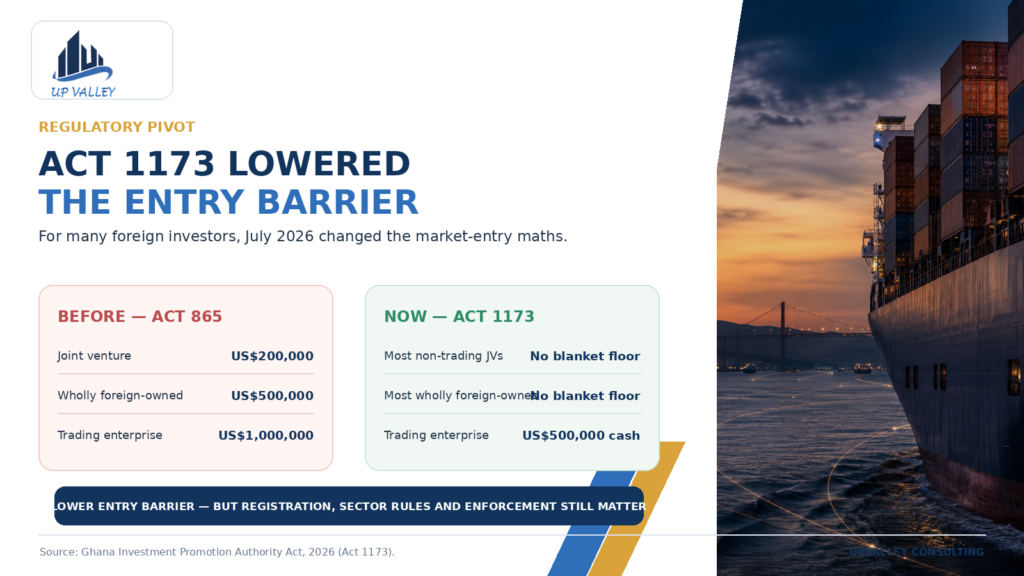
1. The general minimum capital thresholds are gone for most sectors
Under Act 865, a foreign investor in a joint venture had to show $200,000, and a wholly foreign-owned enterprise $500,000. Those floors priced out technology, professional services and agribusiness entrants whose capital need at launch was a fraction of the figure. Trading is the exception and now requires $500,000 in cash, replacing a $1 million requirement that could be met with imported goods.
2. Enforcement is sharper
Act 1173 introduces criminal sanctions alongside administrative fines for operating without a valid certificate or supplying false information in an application. Registration was always mandatory at any level of foreign shareholding. It has become expensive to treat as a formality.
3. GIPA is named as Ghana’s national focal institution for the AfCFTA Protocol on Investment
That puts a mechanism behind the Accra location of the AfCFTA Secretariat rather than proximity alone.
Where the Gateway Case Holds
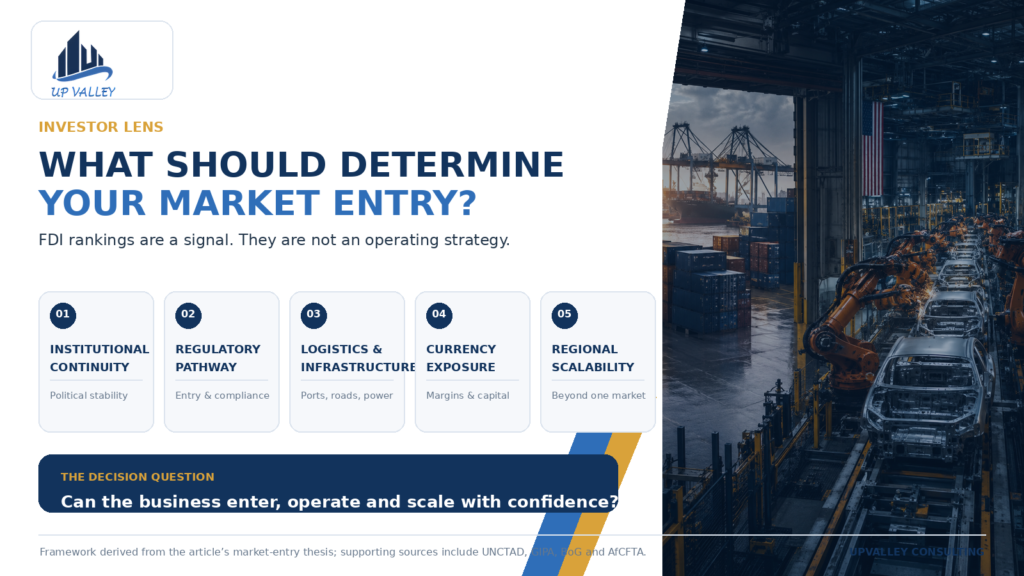
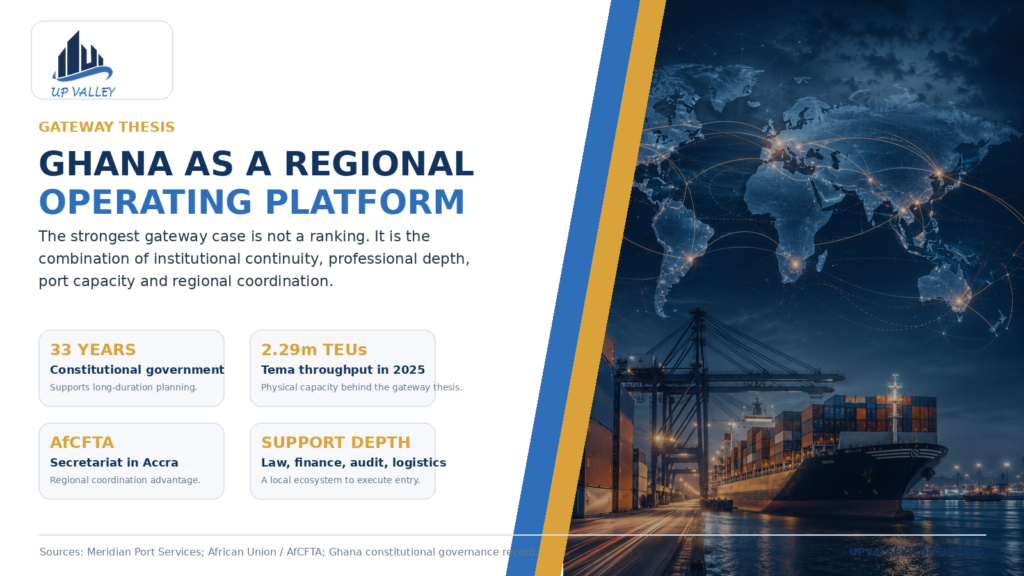
Institutional continuity – Ghana has held constitutional government and peaceful transfers of power since 1993. That does not remove policy risk. It lowers the probability that a multi-year permit, contract or workforce commitment is voided by institutional rupture, which is the risk that ends long-duration projects.
Administration in English – Contracts, regulatory filings, employment documentation and board reporting run in the language most international investors already use. The saving is unglamorous and real, measured in weeks of translation and misreading avoided.
A functioning support market – Banks, audit and law firms, logistics operators and technology companies are present in Accra at sufficient depth to assemble a project team locally. Entry rarely fails on one headline factor. It fails when there is nobody credible available to do the work.
Port capacity with headroom – Tema’s expanded Terminal 3 was officially inaugurated in November 2025. It handled a record 2.29 million TEUs that year against annual capacity of 3 million TEUs, leaving room for additional traffic and giving the gateway case a physical asset to match its policy argument.
Sector spread beyond gold and oil – Agro-processing, financial services, business-process operations and energy infrastructure all carry live opportunities. The strongest cases solve a named constraint: post-harvest loss, a cold-chain gap, inconsistent product quality, or the absence of a formal buyer between producer and market.
Where it does not
Ghana is the wrong answer for some strategies, and saying so is part of the advice. If the plan depends on consumer scale, Nigeria’s market is several times larger. If it depends on a single large resource asset, Guinea is where that capital is currently going. If the operating model is Francophone, Côte d’Ivoire’s infrastructure and agro-industrial base is the stronger platform.
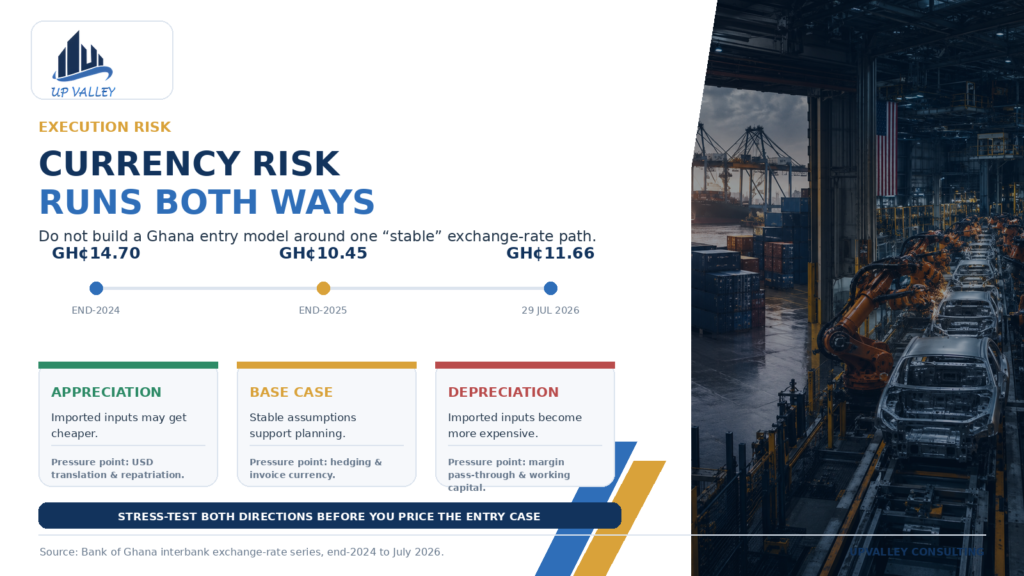
The macro picture has also moved faster than most entry models assume. Headline inflation eased to 4.6% in July 2026 from 5.3% in June. The cedi ended 2025 at GH¢10.45 to the dollar, compared with GH¢14.70 at end-2024, an appreciation of roughly 29% on the Bank of Ghana’s end-period interbank rate.
By 29 July 2026, the daily interbank rate was about GH¢11.66 to the dollar. An entry model built around a single “stable” exchange-rate assumption is therefore already stale.
That is not the currency risk most investors price. Everyone models depreciation. Fewer model a sharp appreciation followed by a partial reversal. Both can break a landed-cost model built on one exchange-rate assumption or a supply contract denominated in the wrong currency. Scenario-test the rate in both directions rather than treating recent stability as a baseline.
Port capacity is not the same as corridor performance. Roads, border procedures, power reliability and the cost of reaching neighbouring markets still determine whether Tema works as a regional platform. Ghana’s wider inland network also remains uneven: in May 2026 the World Bank approved $500 million to rehabilitate and maintain more than 1,000 kilometres of rural roads under the Ghana Market Access and Connectivity Project. Infrastructure quality, land documentation and administrative timelines vary by site rather than by country. Verify them at project level. A national average will not tell you whether your plot has clean title or your industrial area has reliable power.
Investor Takeaway
Use Ghana as a regional platform when the strategy values institutional continuity, professional depth and staged expansion. Choose a peer market when scale, a single megaproject or a Francophone operating model is the overriding requirement. Either way, rebuild the entry model on Act 1173 rather than Act 865.
A market-entry sequence that reflects the new law
- Decide what Ghana is for – Primary market, production base, services hub, or first node of a wider West African build. The answer governs everything downstream, and it is the question most entry plans skip.
- Validate commercially before structuring legally – Test demand, pricing, customer concentration and distribution economics first. Legal structure is cheap to change before incorporation and costly after.
- Map the regulatory path under Act 1173, not Act 865 – Confirm GIPA registration requirements, whether your activity sits on the revised reserved list, sector licences, tax treatment and immigration quota. Advice written before July 2026 is out of date on the capital thresholds.
- Verify the partner rather than the introduction – Ownership, financial capacity, reputation, political exposure and incentive alignment, established independently.
- Build the currency case in both directions – Model landed cost, debt service and repatriation under appreciation and depreciation. Match revenue and cost currencies where the business allows.
- Pilot on a limited footprint – Contract manufacturing, a distributor agreement or a minority position will teach you more in six months than another quarter of desk research.
- Write the regional plan before you need it – Treat Ghana as node one, with dated, market-specific plans for the next two economies.
What to watch next
Ghana’s gateway position does not rest on winning an annual inflow ranking, and the 2025 figures show why. It rests on whether Act 1173 translates into faster registration, clearer treatment of reserved activities and consistent enforcement. The first cohort of investors to register under GIPA will demonstrate that within months, and their experience will be a more useful indicator than next year’s FDI table.
For anyone sizing an entry now, the removal of the capital thresholds has opened a window that did not exist in June. Smaller service and technology entrants can build a Ghanaian presence proportionate to their actual capital need for the first time since 2013. How long that window stays open depends on how the commencement provisions and the revised reserved list are applied in practice, which is the subject of the next article in this series.
Upvalley Consulting
We build market-entry cases for investors moving into West Africa: regulatory pathway mapping, partner due diligence, currency and capital structuring, and staged regional expansion planning.
If you are structuring a Ghana entry under Act 1173, the capital-threshold change may alter what your entity should look like. Send us the sector and the target holding structure and we will tell you what has moved.