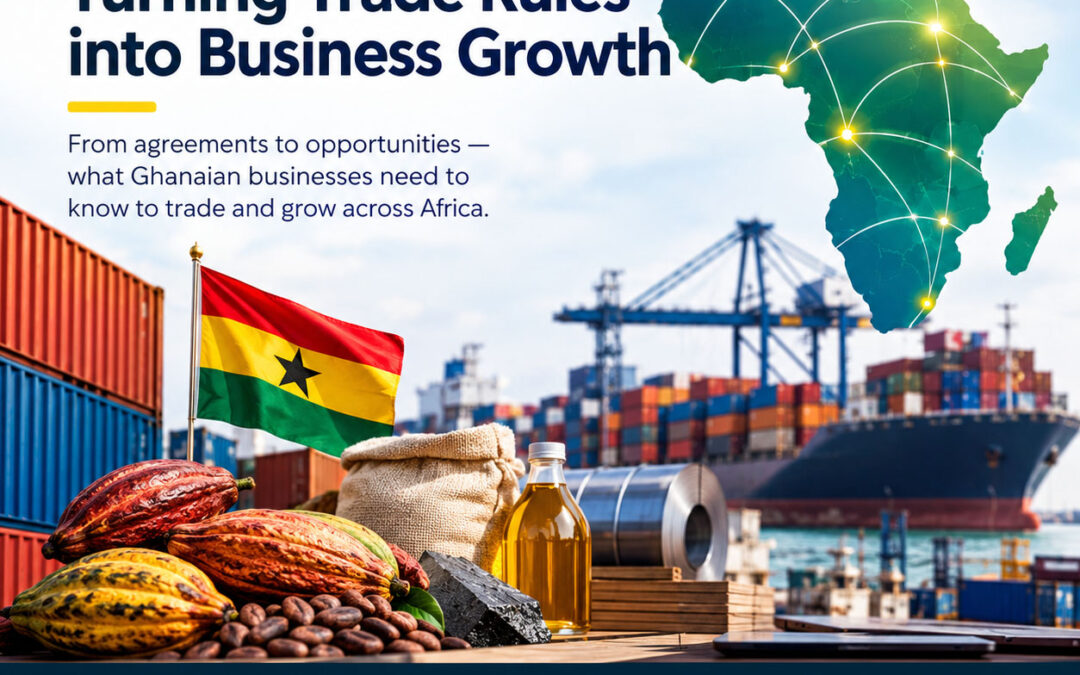
The African Continental Free Trade Area creates a larger commercial framework, but tariff preferences do not convert themselves into sales. Ghanaian firms and investors need product-level evidence, origin compliance, workable payments, reliable logistics and disciplined market entry.
At a glance
- AfCFTA is a rules-based route to lower trade friction, not an automatic continent-wide zero-tariff regime.
- The largest gains depend on trade facilitation, lower non-tariff barriers and better services, not tariff cuts alone.
- For Ghanaian businesses, the practical question is whether a specific product can qualify, clear customs, reach a buyer and be paid for at a competitive landed cost.
A large agreement with an execution test
The Agreement Establishing the African Continental Free Trade Area was signed in 2018, entered into force in 2019 and became the basis for preferential trading from January 2021. Its scale is commercially important. The World Bank described the area at launch as a market of about 1.3 billion people with a combined gross domestic product of roughly US$3.4 trillion. [1][2] Yet those headline figures describe the size of participating economies, not the demand available to any one exporter.
The distinction matters because the strongest estimates are conditional. A World Bank simulation found that full implementation, including measures to reduce non-tariff barriers and improve trade facilitation, could raise Africa’s real income by about 7 per cent by 2035 and lift around 30 million people out of extreme poverty. [2] These are modelled gains under an implementation scenario. They are not guaranteed returns for firms, sectors or countries.
What has changed for companies
Tariff preferences now have operating tools
AfCFTA trading depends on national tariff schedules and product-specific rules of origin. An exporter therefore needs more than a destination and an invoice. The business must classify the product correctly, check the importing country’s applicable concession, prove that the product meets the origin rule and obtain the required certificate and customs documentation. The AfCFTA e-Tariff Book helps firms examine tariff offers, while the legal texts define the wider framework. [1][5]
This is where many attractive ideas fail the commercial test. A product assembled in Ghana does not necessarily qualify as Ghanaian simply because the final step happened locally. The relevant origin rule may depend on a change in tariff classification, a value-added threshold or specified processing. Firms should establish eligibility before quoting a preferential price or committing production.

Trading has moved beyond demonstration
The Guided Trade Initiative began in 2022 to test trading under AfCFTA preferences and expose implementation problems. Ghana was among the first participating countries. A 2024 update from the United States International Trade Administration recorded Ghanaian shipments under the initiative and noted the practical role of certificates of origin and customs procedures. [7] The lesson is modest but useful: the agreement can support actual transactions, while documentation and border processes still determine whether a shipment moves smoothly.

Payments and information infrastructure are improving
The Pan-African Payment and Settlement System is designed to let a payer initiate a cross-border payment in one African currency and allow the beneficiary to receive funds in another, with central-bank and commercial-bank participation. [4] It can reduce the need for every transaction to pass through a third currency, but it does not remove foreign-exchange, bank-onboarding, pricing or counterparty risk. Businesses still need to confirm whether their banks and target markets are connected and what fees, limits and settlement conditions apply.

Why opportunity does not automatically become growth
Three gaps repeatedly separate policy from performance. The first is information. General awareness of AfCFTA is not enough: firms need product-level demand data, buyer requirements, tariff treatment and route economics.
The second is non-tariff friction. Licensing, product standards, border delays, duplicate inspections and inconsistent administrative practice can erase a nominal tariff advantage. The AfCFTA’s online non-tariff-barrier mechanism gives traders a route to report obstacles, but businesses should also price delay and compliance into the commercial model. [6]
The third is productive capacity. A firm cannot benefit from preferential access if it cannot supply the required volume, quality, packaging and delivery schedule. The World Bank’s later assessment of AfCFTA and investment emphasises that deeper integration can attract foreign direct investment and support regional value chains, but the result depends on credible reforms and complementary infrastructure. [3] Market access and production readiness have to advance together.

A practical route for Ghanaian firms
1. Start with demand, not the agreement
Choose a product-market pair and identify real buyers, competing suppliers, standards, order sizes and price points. A continental strategy is too broad to execute. A firm needs a first market and a testable customer proposition.
2. Prove eligibility before pricing
Confirm the HS classification, tariff concession, rule of origin and required evidence with the relevant customs and trade authorities. Build a product-cost record that can withstand an origin review. Do not advertise duty savings until eligibility is confirmed.
3. Calculate the full landed cost
Add freight, insurance, port and border charges, testing, brokerage, financing, taxes outside the preference, expected delay and currency movement. Compare that result with the customer’s current alternative, not only with the factory-gate price.
4. Design the operating chain
Select the importer, distributor, logistics provider, bank and compliance advisers. Verify beneficial ownership, licences, service levels and dispute arrangements. Where possible, pilot a smaller transaction before scaling.
5. Learn from the first shipment
Record every delay, extra document, cost variance and buyer objection. The first transaction should produce an operating playbook for the next one. This is how a trade preference becomes a repeatable route to market.

Where Upvalley adds value
Upvalley’s role is to connect research with execution. For an investor or Ghanaian enterprise, that means testing market demand, mapping the regulatory and origin requirements, evaluating local partners, modelling the landed cost and coordinating the steps needed for a pilot transaction. The value is not in repeating the promise of a single African market. It is in showing whether a specific opportunity can work, where it may fail and what must be done next.
Conclusion
AfCFTA has created a more credible framework for continental commerce, supported by tariff schedules, origin rules, a non-tariff-barrier mechanism, payment infrastructure and early trading experience. None of those instruments eliminates execution risk. Firms that benefit will be those that combine market evidence with compliance, logistics, financing and local relationships. For Ghana, hosting the AfCFTA Secretariat is strategically useful. The commercial dividend will come from businesses that turn proximity to the institution into better decisions and repeatable trade.
Sources
- African Union, Agreement Establishing the African Continental Free Trade Area. Legal text and treaty status.
- World Bank, The African Continental Free Trade Area: Economic and Distributional Effects. 2020.
- World Bank, Making the Most of the African Continental Free Trade Area. 2022.
- Pan-African Payment and Settlement System, How PAPSS Works. System description.
- AfCFTA Secretariat, AfCFTA e-Tariff Book. Tariff information tool.
- African Union and AfCFTA Secretariat, Non-Tariff Barriers Reporting Mechanism. Trader reporting platform.
- United States International Trade Administration, Ghana AfCFTA Guided Trade Initiative Update. 17 April 2024.