
Africa’s investment story is expanding into the systems that help businesses produce, connect and serve customers. For investors considering Ghana and West Africa, the opportunity lies in identifying a specific commercial need and building a credible route to meet it.
An electric motorcycle creates demand for batteries, maintenance and rider finance. A medicine factory needs dependable suppliers, quality assurance and distribution. A data centre depends on power, connectivity and customers who will pay for reliable service.
These connections matter when assessing foreign direct investment (FDI) opportunities in Africa. They reveal possible entry points beyond the large projects that dominate investment headlines. A business does not always need to own the main asset to participate in the value chain around it.
What the latest FDI figures actually tell us
According to UNCTAD’s latest assessment of investment in Africa, the continent attracted about US$70 billion in FDI in 2025, its third-highest level since 1990. That was below the US$94 billion recorded for 2024 in the same assessment, when a small number of large transactions lifted the total.
The picture is more nuanced than a simple rise or fall. UNCTAD reports that the value of announced greenfield projects, investments in new facilities or operations fell by almost a third in 2025, while the number of announced projects increased. More announcements do not necessarily mean more capital arriving, or stronger demand in every sector.
Three measures deserve separate treatment: recorded FDI inflows, announced project values and financing commitments. An announcement describes an intention; financing supports a project; recorded inflows measure cross-border investment under a defined statistical framework. None, on its own, proves that a facility is operating or that a supplier has a profitable contract.
The useful question is therefore: where is investment creating a need that your business can meet competitively?
Electric mobility: look beyond the vehicle
Electric mobility offers a practical example. In November 2025, Afreximbank’s Fund for Export Development in Africa (FEDA) announced a US$75 million investment in Spiro, an African electric-mobility company. The announcement is evidence of investor interest in the business; it does not establish the size of every national electric-vehicle market.
For a prospective entrant, the surrounding operating model deserves close attention. Battery availability, servicing, spare parts, charging or swapping locations, and vehicle finance can determine whether an electric motorcycle works economically for its rider.
A business considering Ghana should test the customer’s daily route, current fuel and maintenance costs, ability to pay, and access to dependable support. A successful model elsewhere is a starting point for research. Local unit economics must justify the decision to enter.

AI-generated illustration: mobility depends on batteries, servicing and an operating network; not a photograph of Spiro.
Pharmaceuticals: production needs a dependable market
Healthcare investment can connect manufacturing with distribution and technical capability. In December 2025, Impact Fund Denmark announced approximately US$10 million for Crown Healthcare, supporting a medicine factory then under construction in Kenya. The stated purpose was to strengthen local production and supply to Kenya and the wider region.
That example illustrates a production opportunity, rather than a guarantee of returns across African pharmaceutical markets. A factory still needs approved products, consistent quality, reliable inputs and customers whose purchasing arrangements support sustainable cash flow.
UNIDO’s guidance on pharmaceutical technology transfer and investment emphasises partnerships, technical competence, quality assurance and bankable project design. These are useful considerations for manufacturers, distributors and service providers assessing an entry strategy.
For Ghana and neighbouring markets, the diligence should cover product registration, manufacturing or distribution requirements, procurement channels, payment cycles and storage conditions. Serving a clear product or distribution gap is a more defensible proposition than relying on a broad claim that medicines are in demand.
Minerals: examine the business case for local processing
Minerals remain central to Africa’s investment story. Opportunities beyond extraction can develop through processing, industrial services and the supply chains that support them.
In November 2025, FEDA announced a US$300 million investment in the Africa Minerals and Metals Processing Platform. This provides a concrete example of capital being directed towards mineral processing. It should be described as an announced investment, rather than proof that all planned capacity has been delivered.
Processing adds value only when the economics work. Investors need to assess feedstock access, electricity costs, transport, environmental obligations, technical capability and the terms on which buyers will purchase output. A resource deposit is one input into that calculation.
Potential suppliers should establish which services a project will procure locally, when procurement begins, and what qualification standards apply. A promising national resource profile does not replace a verified customer or a realistic contract pipeline.
Digital infrastructure: connectivity creates operating opportunities
Digital investment extends beyond consumer apps. Fibre networks, data hosting and dependable enterprise connectivity are part of the infrastructure businesses use to operate.
IFC’s WIOCC investment disclosure, updated in August 2026, describes financing to support cable deployment in South and West Africa and additional data-centre capacity, primarily in Nigeria and South Africa. Its project record lists an investment event in May 2026. The disclosure gives a more specific view of investment activity than a continent-wide digital growth forecast.
For businesses assessing Ghana, possible areas to investigate include enterprise connectivity, managed technology services and support for firms adopting digital systems. The commercial test is whether a defined customer group needs the service, can afford it and will choose it over existing alternatives.
Power availability, network resilience, cybersecurity requirements and applicable data rules belong in the operating plan from the beginning. They influence both service quality and cost.
Energy: an opportunity and a condition for other investments
Energy investment also supports the viability of manufacturing, digital infrastructure and other businesses. A project’s power requirements can shape its location, capital needs and operating margins.
The African Development Bank reports that its Sustainable Energy Fund for Africa approved 13 projects totalling US$97 million in 2025. These are fund approvals, not a measure of Africa’s total energy FDI or confirmation that every project has been completed.
For investors and suppliers, the practical questions concern the customer, the payment arrangement, project readiness and the cost of delivering dependable power. Businesses evaluating their own operations should compare grid supply, backup provision and on-site generation against actual requirements and current local costs.
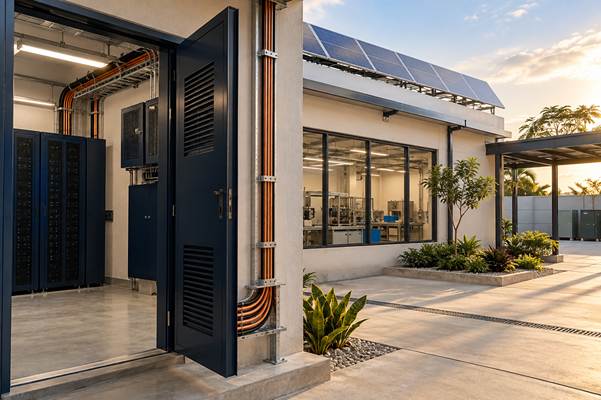
AI-generated illustration: digital and industrial operations rely on physical infrastructure; not a photograph of a named project.
Turning an African trend into a Ghana or West Africa entry plan
Continental figures help identify where to investigate. Market entry requires a narrower decision: a product, a customer, a location and an operating model.
Before committing capital, establish five things:
- Paying demand: Who buys, what problem are you solving, and what evidence supports the expected price and volume?
- A credible route to market: Which distributors, partners or procurement channels can reach those buyers, and how have you verified them?
- Permission to operate: Which registrations, licences, product approvals and other requirements apply to the proposed activity?
- Viable economics: Can the business withstand financing costs, currency movements, delayed payments, distribution costs and infrastructure constraints?
- An executable first step: What can a pilot or initial contract establish before a larger commitment?
For a regional strategy, tariff preferences are only part of the calculation. UpValley’s article on turning AfCFTA rules into a workable route to market explains why product eligibility, documentation and practical trade conditions matter. Its guidance on managing political and economic risks when investing in Africa provides a complementary framework for assessing exposure.
Build the decision around your business
The investment cases above point to opportunities in production and the services that make it possible. Their relevance depends on the market you intend to serve and the capabilities you bring. If you are assessing Ghana or West Africa, start with your sector, target customer and intended entry timeline. Explore UpValley Consulting’s business development support and discuss the research, partnerships and execution planning your next move requires.